Category:
Insights
Published On:

Amber Spencer
The hidden cost of validation in planning: Time, money, and the price of waiting
Why validation requires modernisation now and how Planda Portal delivers a ready-to-use solution.
Summary:
Validation is a largely preventable material cost to local government.
High invalidity rates consume officer time and public money.
Government-backed research quantifies the scale of this cost.
We use our data to combine that research with real 2025 planning application volumes per council.
This allows us to estimate the time and cost that could be released per authority if validation work is automated and enhanced at source.
No single solution fixes validation overnight - but reducing avoidable waste now matters while longer-term reform continues.
Planda Portal represents a practical, upstream intervention available today, reducing invalid submissions before they reach planning teams and releasing capacity without new policy, legislative change, or additional public spending.
Validation: An avoidable money pit
Before a planning application can be assessed, it must be validated.
Validation is the administrative process performed by planning officers that checks whether an application is complete, correctly formatted, and supported by the required documentation. Applications are checked against both national and local validation requirements. It involves reviewing forms, checking plans, confirming certificates, identifying missing information, and corresponding with applicants to resolve issues.
This work is essential. But it is also largely manual, repetitive, and resource-intensive.
Around 50% of applications are submitted invalid. When this happens, officers must re-check submissions, chase corrections, and re-validate applications - often multiple times.
Individually, each invalid application may seem minor. Collectively, they consume thousands of officer hours per authority each year. Over time, this creates a significant but under-recognised cost for local government.
What government’s research tells us about validation costs
The government-commissioned Reducing Invalid Planning Applications (RIPA) Alpha Benefits Case modelled the administrative cost of validation work for local planning authorities and the savings that could be achieved by materially reducing invalid submissions.
RIPA’s baseline assumptions for a typical authority were:
1,400 planning applications per year
50% invalidity rate
£50 per hour officer cost (including salary, on-costs, and overheads)
Validation time per application:
Valid applications: 1-4 hours
Invalid applications (including multiple returns): 2-5 hours
Using these assumptions, RIPA calculated the annual cost of validation for a single authority at 50% invalidity to be:
Low estimate: £105,000 per year
High estimate: £315,000 per year
They then modelled a future scenario in which validation tools reduce invalidity by 80%, bringing the invalid rate down from 50% to 10%. Under this scenario, both the number of invalid applications and the time spent validating each application fall significantly.
In that future state, RIPA estimated validation costs per authority to reduce to:
Low estimate: £38,500 per year
High estimate: £143,500 per year
The resulting annual saving per authority was therefore calculated as:
£66,500 (low estimate)
£171,500 (high estimate)
When scaled nationally across 326 local authorities, RIPA estimated total annual local authority savings of:
£22 million to £56 million, assuming full adoption
These assumptions and calculations form the methodological foundation for our analysis.
Combining RIPA’s framework with real 2025 planning activity
RIPA’s analysis is based on average application volumes per authority.
Using our IBex planning application data, we know exactly how many applications were submitted to each council in 2025. Applying RIPA’s framework to those real volumes lets us estimate - authority by authority - the scale of officer time currently absorbed by invalid submissions and the associated administrative cost, then model what could be released as validation is automated and reduced at source.
Our modelling follows RIPA’s logic closely:
Invalid applications are assumed to waste 2 hours of officer time each - a deliberately conservative assumption within RIPA’s 1-5 hour range.
Officer time is valued at £55 per hour, reflecting modest inflation since RIPA’s original £50 estimate in 2019-20.
Invalidity reduction is modelled at full potential, consistent with RIPA’s evidence that around 80% of invalid reasons are preventable.
We’ve published the results in an interactive table on Planda Portal’s website, where you can check and find each council’s estimated 2025 validation savings under this scenario.
This accurately shows the scale of time and money currently tied up in validation work per authority, and what could be released. When aggregated nationally, the estimated savings run into tens of millions of pounds each year.
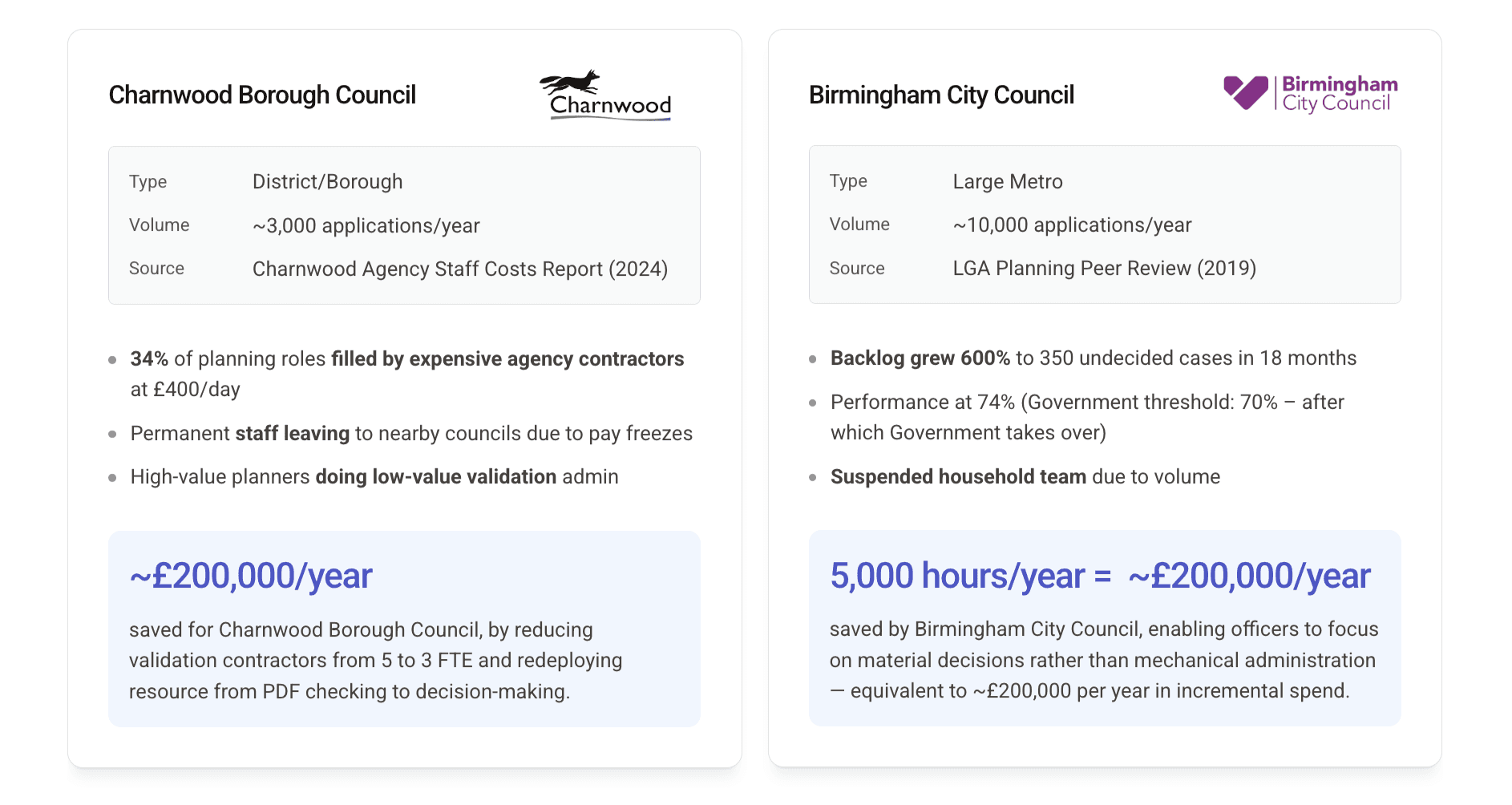
Example council saving reports with Planda Portal
What this tells us about planning reform and housing delivery
Validation absorbs officer time before assessment even begins.
When large volumes of that time are spent on avoidable administrative work, capacity is lost for decision-making, engagement, and delivery.
By lowering the volume of invalid submissions and repeated checks, councils can:
Free officer time
Redirect preventable administrative costs
Reduce backlogs
Improve throughput
Help applications progress more quickly through the system
Untying the validation knot isn’t a silver bullet for the Government’s agenda to overhaul the planning system, but it is a seriously meaningful lever.
Why now matters most: Where Planda Portal fits

No tool eliminates validation issues overnight.
Councils operate within national requirements, but also have their own unique set of local validation rules, and training data models against each one takes time and coordination. Alongside this, validation often relies on professional judgement to interpret requirements in context. Government-backed programmes are opening up, but tangible benefits are yet to materialise and are costing more public funding to mature.
In the meantime, validation costs continue to accrue. This is where we step in.
Planda Portal is a new planning application submission platform designed to reduce validation friction upstream and streamline communication between applicants and councils. With the integration of Ava (our application validation assistant) into the platform, Planda Portal validates applications against national requirements before submission, reducing avoidable invalids before they reach planning teams. With Planda Portal’s officer-first design, local authorities always retain the final say.
As a result, Planda Portal can actively save each council the annual costs displayed in our analysis, today. These vary from £50,000-£500,000 per local authority. As logic develops and coverage expands, these savings will increase further.
Importantly, Planda Portal has not required new policy, legislative change, or additional public funding to operate at its current level. It works within existing rules and processes, focusing on the practical task of reducing invalid submissions and repeat validation work.
Closing reflection
Current validation is impacting public spending and absorbing officer time, with delays rippling through the planning system. Reducing this friction doesn’t need to depend on sweeping policy change, which can take years and substantial public funding to deliver.
The journey to a streamlined validation pipeline can start today with Planda Portal.
Planda Portal is built with officers, for officers, to reduce friction rather than add complexity. While it does not eliminate validation challenges overnight, it offers a practical, cost-efficient way to reduce waste now.
Reducing today’s validation bottleneck allows for the reallocation of public funds. It also helps the planning system operate more efficiently, supports officers better, and creates capacity for housing delivery and future reform.
Get Started
If you're a homeowner, agent, or architect, visit plandaportal.co.uk to learn more or subscribe to our newsletter
If you're a local authority, get in touch with our team to learn how onboarding works.
Subscribe to our Newsletter!