
Category:
Pipeline
Published On:

Amber Spencer
The Pipeline - Issue 04: Building Through the Base Rate
In this issue: the numbers say developers shouldn't be all that confident right now, but they are. We dig into our IBex data to explain why new residential applications have jumped back to pandemic-era levels despite a base rate still sitting at 4%, and make the case for planning reform as the driver. Then, in Standout Projects, we spotlight two very different applications that have passed through Planda Portal - from a hedgehog hospital extension to a brownfield-to-employment-hub scheme in Derby. Finally, we introduce a new regular feature, Building Spotlight, where each edition we'll pick out a piece of interesting architecture, starting with South Kensington's "Thin House."

The NPPF Effect: Labour's Planning Reforms Show Up in the Data
Welcome back to Build, Baby, Build. Each edition we're digging into what's happening on the ground in UK planning. Here's the puzzle we set out to solve: mortgage rates have been painful, and the cost of borrowing for developers has come down in recent years but remains high, with the base rate still sitting at around 4%. In that kind of environment, you'd expect application volumes to hold steady at best - not climb. Instead, a look into our IBex data reveals applications for new residential units have climbed back to levels last seen in the near-zero interest rate environment of the pandemic.
What our data shows
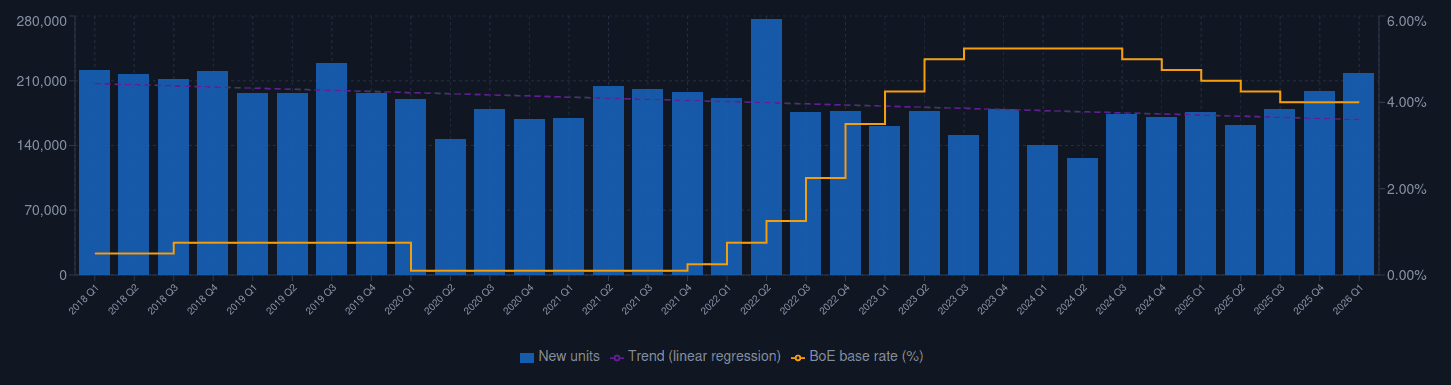
Having tracked application volumes across the planning pipeline for new residential units, quarter on quarter, using IBex, and layering in the macro context - in this case, the Bank of England base rate - we've discovered a reason to be hopeful. According to our data, in Q1 2026 new residential applications hit their highest level since 2022, effectively going beyond the increased volumes of application activity we witnessed in a 0% interest environment, even though the base rate now sits at around 4%.
So what makes this increase interesting is the timing. You’d expect a relatively high base rate that’s stayed consistent for six months to equate to a steady application stream at best: Instead, application volumes are behaving as if money were cheap. That gap - strong activity despite expensive borrowing - is the signal that something else is driving developer confidence. The strongest candidate is heightened planning reform.
The deep dive: what's behind the pipeline
Several key pillars of Labour’s planning reform stand out as the primary catalysts for this shift in activity:
The Return of Mandatory Targets: In early 2023, the previous administration shifted local housing targets to advisory status. Labour quickly reversed this, making targets binding once more and increasing the national goal to 370,000 homes annually, a move that forces council accountability and bolsters developer certainty.
Unlocking the Grey Belt: By reclassifying neglected Green Belt land, such as disused car parks and brownfield sites within the Green Belt, the government has created a new category of developable land that was previously off-limits.
Financial Backing for Brownfield Sites: To prioritise urban regeneration, the government allocated £68 million to more than 50 local authorities, specifically intended to ready brownfield locations for construction.
Accelerating Stalled Developments: The newly established New Homes Accelerator programme focuses on unblocking projects currently caught in planning red tape or left partially completed.
Comparing these policy shifts with market data reveals a distinct trend. After a spike in Q2 2022, new build applications plummeted as the Bank of England hiked interest rates in response to global inflation shocks. Applications remained suppressed while the base rate was at its peak, only beginning a modest recovery in late 2024 as rates started to soften.
What is notable, however, is the recent surge in applications despite the base rate remaining high at approximately 4%. This growth mirrors the activity seen during the pandemic’s era of near-zero interest rates, suggesting that confidence is being driven by structural policy reform rather than cheaper borrowing.
The Takeaway
Applications are a leading indicator, but they’re not a finished home. The real test is how many of these schemes convert into homes people can move into, and the government's own numbers show completions still running behind the 370,000 target this year.
It's worth watching who's steering next. Andy Burnham, the frontrunner to succeed Keir Starmer as Prime Minister, used his first major policy speech this week to put devolution and council house building at the centre of his platform - pledging the biggest council housebuilding programme since the post-war period, delivered through a new "Number 10 North" based in Manchester. If that vision takes shape, it points to a planning system with even more local muscle behind it, and renewed political attention on getting council-led schemes moving.
Faster planning decisions increasingly depend on the systems local authorities and developers use to process, track, and validate applications, and digital tools are moving faster in the private sector than public procurement cycles typically allow. Whoever leads next will need to treat technology adoption as seriously as policy reform if the pipeline strength we're seeing is going to convert into homes at the pace the targets demand.

Standout Projects
As of this edition of The Pipeline, Planda Portal has processed thousands of planning applications - from major residential-led developments to smaller, more specialist submissions, each processed with care while Ava catches any issues along the way. Below, we've highlighted a couple of eye-catching applications that have passed through the portal as of late.
A hedgehog hospital extension
Who for: Tiggy Winkles Wildlife Hospital in Haddenham, Buckinghamshire - a working wildlife hospital that describes itself as one of the busiest in the world, treating injured and orphaned British wildlife around the clock, 365 days a year
The proposal: a single-storey extension to enlarge the hospital's mammal nursery room, giving staff more space to treat and rehabilitate the animals that pass through
The architect: Home Countries Architectural Services
Current stage: validated
The nice touch: the design includes a dedicated viewing area, so visitors can watch the nursery in action without disturbing the animals in care
A small-scale application on paper, but behind it sits a facility caring for thousands of injured and orphaned animals every year, a reminder that planning decisions, even small ones, can directly support the infrastructure wildlife conservation depends on.
Vulcan Park, Derby
The applicant: Morgan Industrial Properties, redeveloping a cleared brownfield site on Osmaston Road, Derby
The proposal: a contemporary industrial and commercial scheme comprising seven buildings split into 24 individual units, delivering 7,181 sqm of new floorspace
The architect: Sigma Architects Ltd
Current stage: consultation
The nice touch: the scheme includes photovoltaic panels and EV charging points as standard, alongside a jump from zero to 107 car parking spaces and 21 cycle spaces - turning a long-vacant industrial site into a properly connected, modern employment hub
The site had sat vacant since 2021. This scheme brings it back into active use - replacing a derelict factory footprint with 24 employment units and the infrastructure to support them.

Building spotlight: The Thin House, Thurloe Square
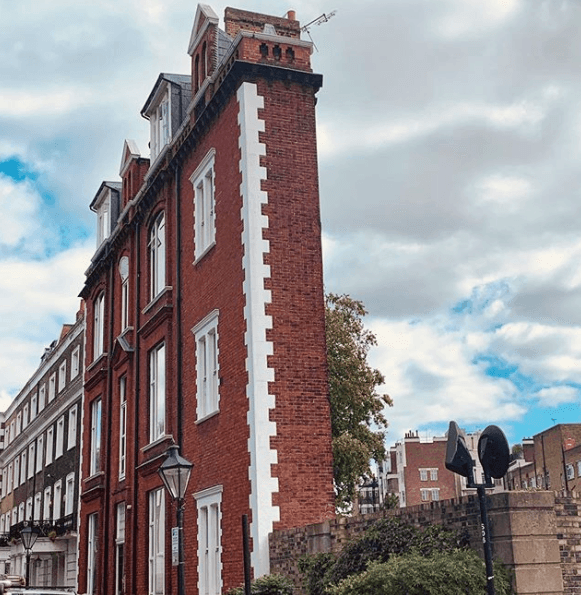
Source: Maskells, "The Story Behind "The Skinny House" in South Kensington"
Tucked into the corner of Thurloe Square in South Kensington sits one of London's most photographed planning quirks: a house that's 34 feet wide when you look at it head-on, but narrows to just 6 feet at its thinnest edge - barely wide enough to stretch your arms out in. From certain angles, it looks almost two-dimensional, like a stage set rather than a real home.
The reason isn't architectural whimsy - it's the London Underground. The site once formed part of Thurloe Square's original terraces, but 23 houses were compulsorily sold to the Metropolitan District Railway in the 1860s to build South Kensington station, leaving a triangular sliver of land behind. It sat vacant for years until local builder William Douglas saw its potential and built the Thin House between 1885 and 1887, originally as seven artists' studios, designed with large north-facing windows to catch the light. Rather than leave the site undeveloped, Douglas worked with the constraint instead of against it, creating a liveable building out of a shape most developers would have walked away from.
It's a nice reminder that some of the most interesting buildings in London exist precisely because of planning and infrastructure constraints, not despite them - proof that a tricky site doesn't have to mean a wasted one.
Subscribe to our Newsletter!